
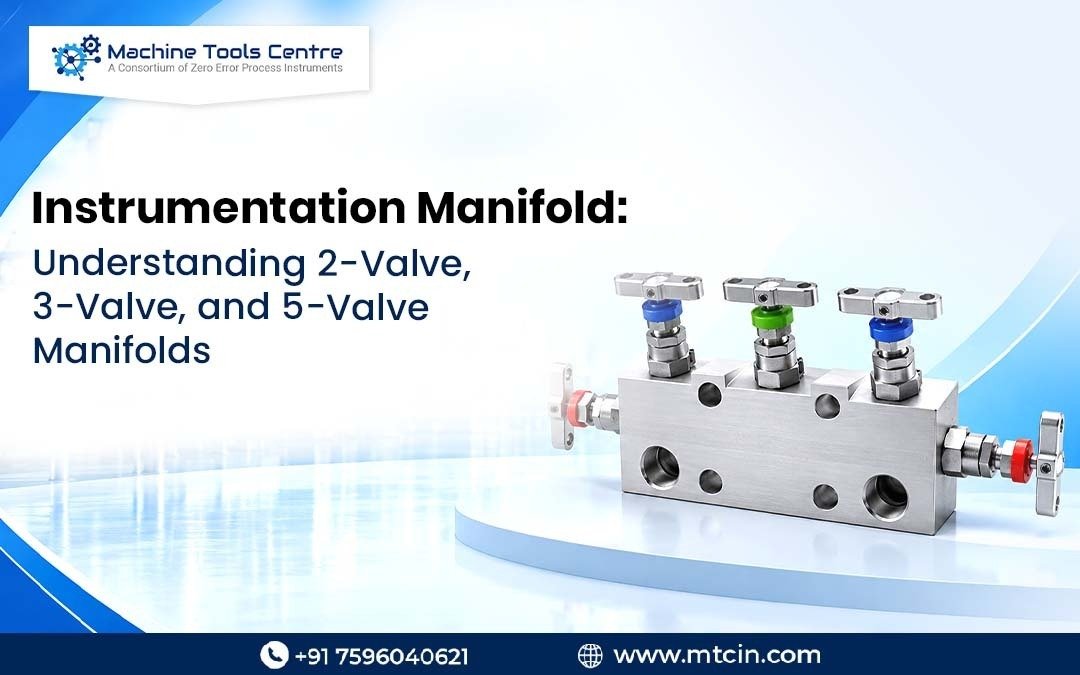
Industrial process measurement systems rely on accurate and reliable instruments to monitor pressure, flow, level, and other critical parameters. However, connecting instruments directly to process lines can make isolation, calibration, maintenance, and testing more difficult. An instrument manifold provides a practical solution by combining valves and connections into a compact assembly.
Instrumentation manifolds are commonly used with pressure transmitters, differential pressure transmitters, gauges, and other process instruments. Depending on the application, different configurations are available, including 2-valve, 3-valve, and 5-valve manifolds. Understanding their functions can help engineers select the appropriate arrangement for a particular measurement system.
What Is an Instrument Manifold?
An instrumentation manifold is a valve assembly designed to control the connection between a process line and an instrument. It can provide functions such as isolation, venting, equalizing, and calibration.
Instead of installing several individual valves and fittings separately, a manifold combines the required functions into a single, compact unit. This can reduce installation complexity while providing convenient access for maintenance and instrument testing.
Instrument manifolds are available in different configurations and materials depending on the process conditions, pressure requirements, temperature, and type of instrument being connected.
What Is a 2 Valve Manifold?
A 2 valve manifold is one of the simpler manifold configurations. It typically consists of two valves that provide isolation and access for instrument maintenance or calibration.
One valve is generally used to isolate the instrument from the process, while the second valve can provide a vent or drain function depending on the specific design.
The 2-valve configuration can be suitable for applications where basic instrument isolation is required. It is commonly used with pressure gauges and other instruments where differential pressure measurement and equalization are not necessary.
The compact design of a 2-valve manifold can also make installation and maintenance relatively straightforward.
Understanding a 3 Valve Manifold
A 3 valve manifold is commonly associated with differential pressure measurement applications. It generally includes two isolation valves and one equalizing valve.
The two isolation valves connect the high-pressure and low-pressure sides of a differential pressure transmitter to the process. The equalizing valve connects the two sides and allows pressure to be balanced when required.
This arrangement provides useful flexibility during commissioning, maintenance, and calibration. For example, the equalizing valve can help establish similar pressure conditions on both sides of the transmitter before certain maintenance or testing procedures.
A 3-valve manifold is therefore commonly selected for differential pressure transmitters and related measurement applications.
What Is a 5 Valve Manifold?
A 5 valve manifold provides additional functionality compared with 2-valve and 3-valve configurations. It generally includes two isolation valves, an equalizing valve, and two additional valves for venting or calibration functions.
The additional valves can allow the instrument to be isolated, equalized, vented, and tested without requiring extensive modifications to the process connection.
Five-valve configurations are particularly useful in applications where convenient calibration and maintenance access are important. They can be used with differential pressure transmitters in industrial process measurement systems.
The exact arrangement and valve functions can vary depending on the manufacturer’s design, so technical specifications should always be checked before selecting a manifold.
2-Valve vs 3-Valve vs 5-Valve Manifold
The primary difference between these configurations is the number of valves and the functions they provide.
A 2-valve manifold offers basic isolation and venting or draining capability. A 3-valve manifold adds an equalizing function, making it suitable for many differential pressure measurement applications. A 5-valve manifold provides additional venting and calibration capabilities for applications requiring greater operational flexibility.
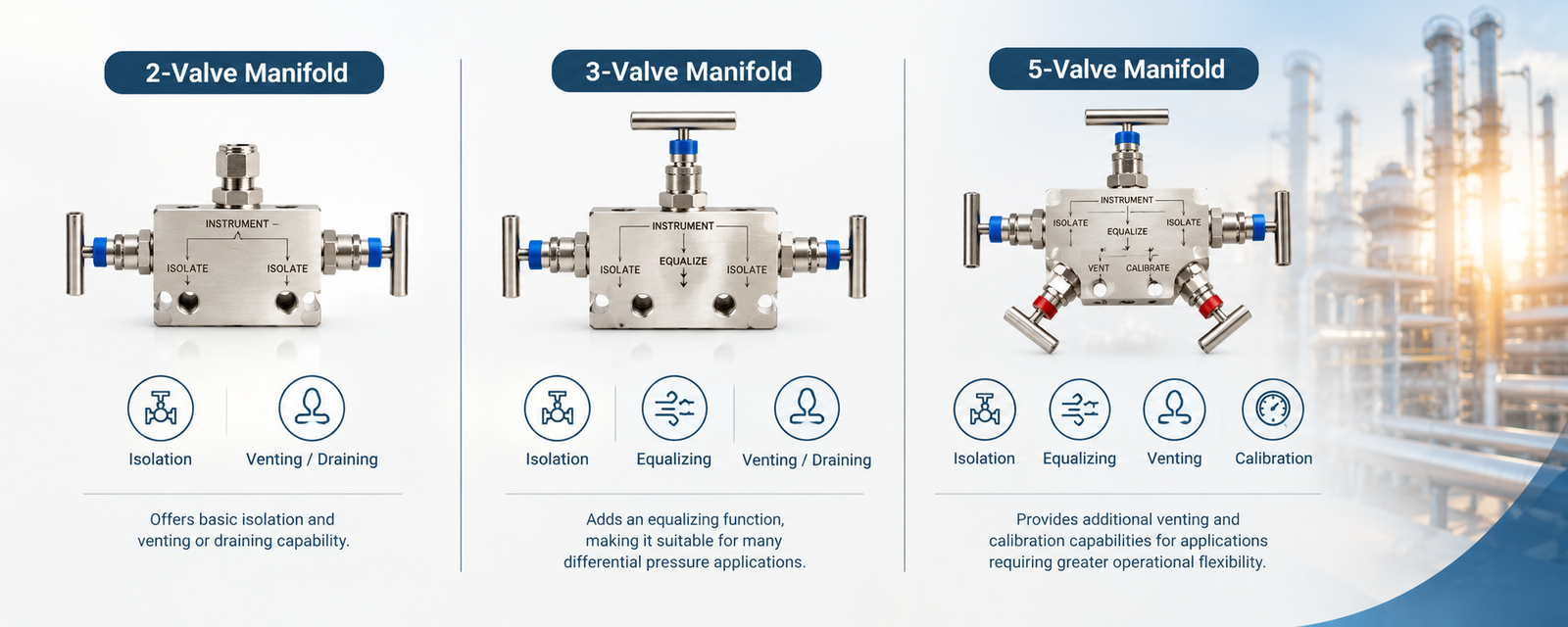 The correct choice depends on the instrument, process conditions, measurement requirements, and maintenance procedures involved.
Benefits of Using an Instrumentation Manifold
Using an instrumentation manifold can provide several practical advantages in industrial measurement systems:
- Compact installation: Multiple valve functions are integrated into one assembly.
- Easy isolation: Instruments can be separated from the process when required.
- Simplified maintenance: Isolation and venting can make servicing more convenient.
- Calibration support: Certain configurations provide useful connections for testing and calibration.
- Reduced leakage points: Integrated construction can reduce the number of separate connections compared with multiple individual components.
- Improved accessibility: Valve arrangements provide controlled access to the instrument and process connection.
Choosing the Right Manifold
When selecting an instrument manifold, engineers should consider the instrument type, process pressure, temperature, fluid compatibility, connection size, material, and required valve configuration.
The manifold material should be compatible with the process medium and operating environment. Stainless steel is commonly selected for many industrial applications, but the appropriate material depends on the specific process.
It is also important to verify pressure ratings, connection standards, valve design, and applicable industry requirements before installation.
Instrument Manifolds for Industrial Applications
For businesses looking for industrial instrumentation and process measurement solutions, MTC Machine Tool Centre (MTC) provides instrumentation products and solutions through mtc. Understanding the application requirements before selecting a manifold can help ensure that the instrument and valve assembly work together effectively.
Conclusion
An instrument manifold is an important component in many industrial instrumentation systems, providing controlled isolation, equalization, venting, and calibration functions. While a 2 valve manifold is suitable for simpler isolation requirements, a 3 valve manifold can provide equalization for differential pressure measurement, while a 5 valve manifold offers additional functionality for venting and calibration.
Selecting the right instrumentation manifold requires careful consideration of the instrument, process conditions, materials, pressure ratings, and maintenance requirements. A properly selected manifold can make measurement systems more practical, accessible, and reliable.
Read More : Instrumentation Manifold full Guide

