
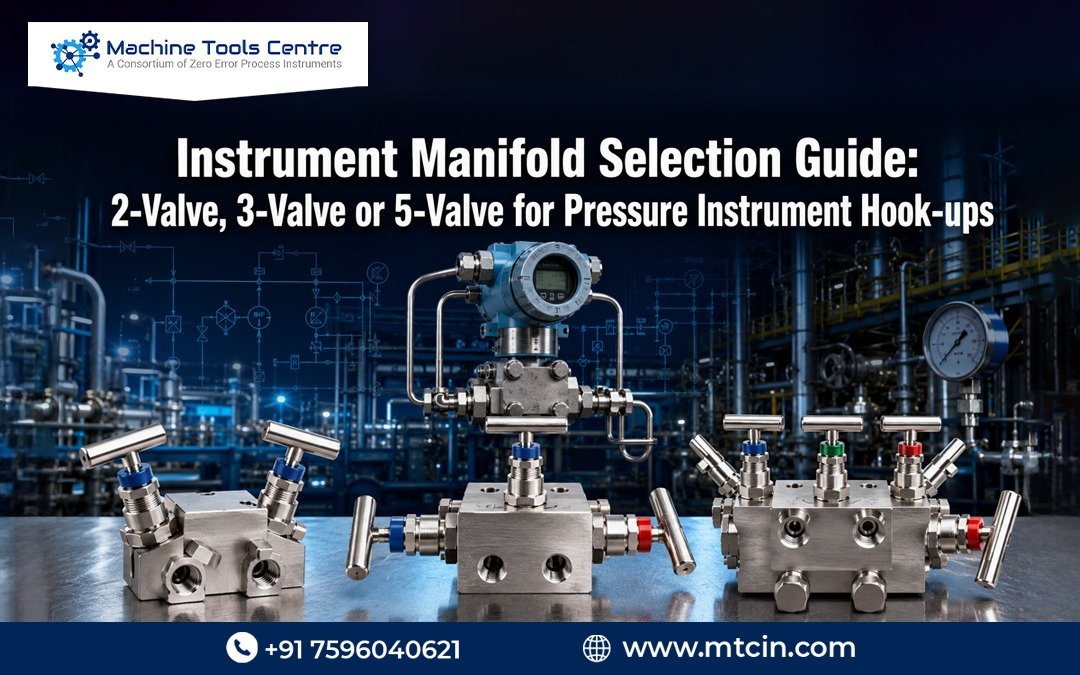
When a pressure transmitter fails early, or a gauge gives unstable readings, the instrument itself is often not the culprit. In many plants we visit, the real problem sits just below the instrument — the wrong pressure instrument manifold, or no manifold at all.
The manifold is a small component, but it decides how safely you can isolate, equalise, calibrate, and vent your pressure instrument without shutting the line. In this instrument manifold selection guide, we explain how to choose between 2-valve, 3-valve, and 5-valve manifolds the way an instrumentation engineer would — by application, not by price.
For the full technology overview, see our Manifold and Hook-up guide.
What Does an Instrument Manifold Actually Do?
A manifold combines isolation, equalisation, venting, and test connections into one compact block mounted between the process line and the instrument. Instead of fabricating 3-4 separate valves with fittings (more joints = more leak points), a single manifold for pressure transmitter or gauge gives you:

Isolation — service the instrument without depressurising the line Equalisation — protect DP instruments from one-sided overpressure during start-up Venting / draining — safely release trapped pressure before removal Test port — inject calibration pressure in-situ
2-Valve Manifold — For Gauge Pressure Instruments
| Feature | Detail |
| Valves | 1 isolation + 1 vent/test |
| Used with | Pressure gauges, pressure transmitters (gauge type), pressure switches |
| Typical service | Pump discharge, compressor lines, steam (with siphon), process headers |
| Why it matters | Lets you calibrate or replace the instrument live, without line shutdown |
If you are installing a pressure gauge or gauge-pressure transmitter on a process line, a 2 valve manifold is the minimum good practice. Direct-mounting with only a root valve means every calibration becomes a small shutdown.
3-Valve Manifold — For DP Transmitters
| Feature | Detail |
| Valves | 2 isolation (HP & LP) + 1 equalising |
| Used with | Differential pressure transmitters — flow (orifice/venturi), level, filter DP |
| Critical function | Equalising valve prevents one-sided pressurisation that can shift the cell zero or damage the diaphragm |
The start-up sequence matters, and this is where most field damage happens: open equaliser → open HP isolation → close equaliser → open LP isolation. Reverse for shutdown. Skipping the equalising step on a high static-pressure line is the most common cause of DP cell zero-shift we see in the field.
5-Valve Manifold — For DP with Vent/Test
| Feature | Detail |
| Valves | 2 isolation + 1 equalising + 2 vent/test |
| Used with | DP transmitters on high static pressure, toxic, or critical service; custody metering |
| Extra capability | Vent trapped pressure safely and inject test pressure on both sides for in-situ calibration |
On refinery and chemical plant service, 5-valve manifolds are standard practice for DP flow measurement — see our Refinery & Chemical Plant Instrumentation Solutions.
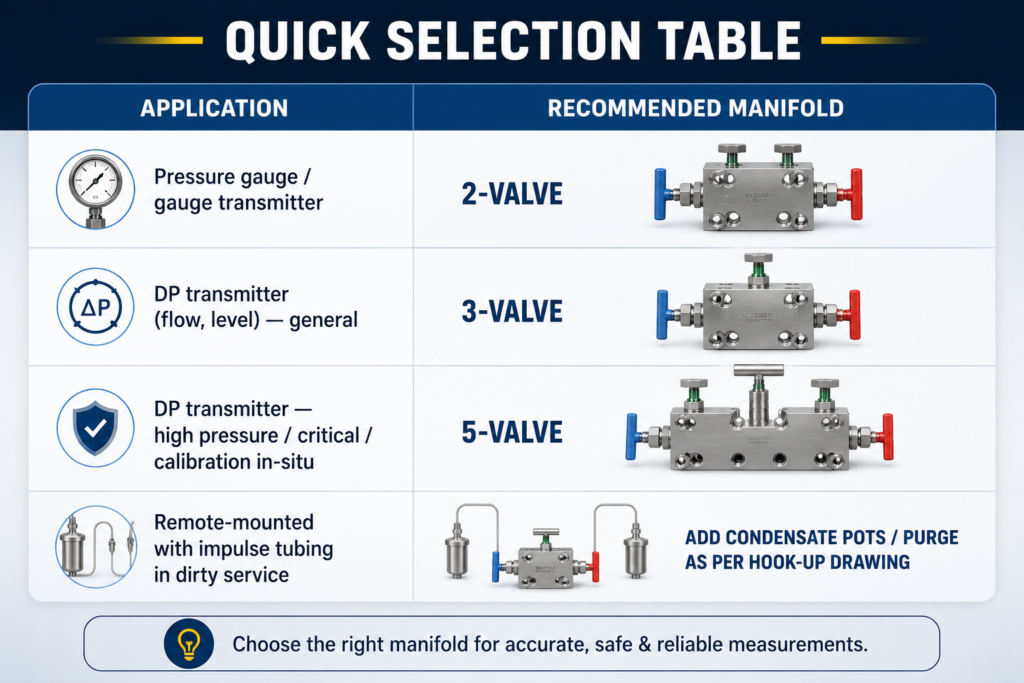
Quick Selection Table
| Application | Recommended Manifold |
| Pressure gauge / gauge transmitter | 2-valve |
| DP transmitter (flow, level) — general | 3-valve |
| DP transmitter — high pressure / critical / calibration in-situ | 5-valve |
| Remote-mounted with impulse tubing in dirty service | Add condensate pots / purge as per hook-up drawing |
Common Hook-up Mistakes We See in Plants
- Equalising valve never used during start-up (zero-shift, diaphragm damage)
- PTFE packing on steam service (leaks within months — use grafoil)
- No vent valve on toxic service (unsafe instrument removal)
- Carbon steel manifold on a corrosive line because “it was in stock”
- Impulse line slope wrong for the medium (gas: slope up to instrument; liquid/steam: slope down)
How Machine Tools Centre Supports Your Hook-up Requirements
We supply complete instrument hook-up packages, including instruments, manifolds, tubing, fittings, siphons, and condensate pots. Our team reviews pressure, temperature, and process conditions to recommend the right Pressure Instrument Manifold, Manifold for Pressure Transmitters, or 2 valve manifold, ensuring compatibility and reliable performance.
Conclusion
The pressure instrument manifold costs a fraction of the transmitter it protects — but the wrong one costs you the transmitter, and sometimes a shutdown. Match the manifold type to the instrument (2-valve for gauge, 3/5-valve for DP), match the material to the process, and follow the correct valve sequence.
For help selecting manifolds and complete instrument hook-ups, Machine Tools Centre is happy to review your application.
Contact Machine Tools Centre
📞 +91 7596 0406 21
📧 dm@mtcin.com
🌐 mtcin.com

