
A pressure gauge that works fine on a compressed air line can fail within weeks on a refinery or chemical plant line. The media are corrosive, the lines vibrate, temperatures run high, and a gauge failure is not just a wrong reading — on hydrocarbon or acid service it is a safety event.
This guide gives the engineering checklist we apply when specifying pressure gauges for refinery and chemical service — the points that decide whether the gauge survives. For the complete instrumentation for refinery plant India approach, see our Refinery & Chemical Plant Instrumentation Solutions page.
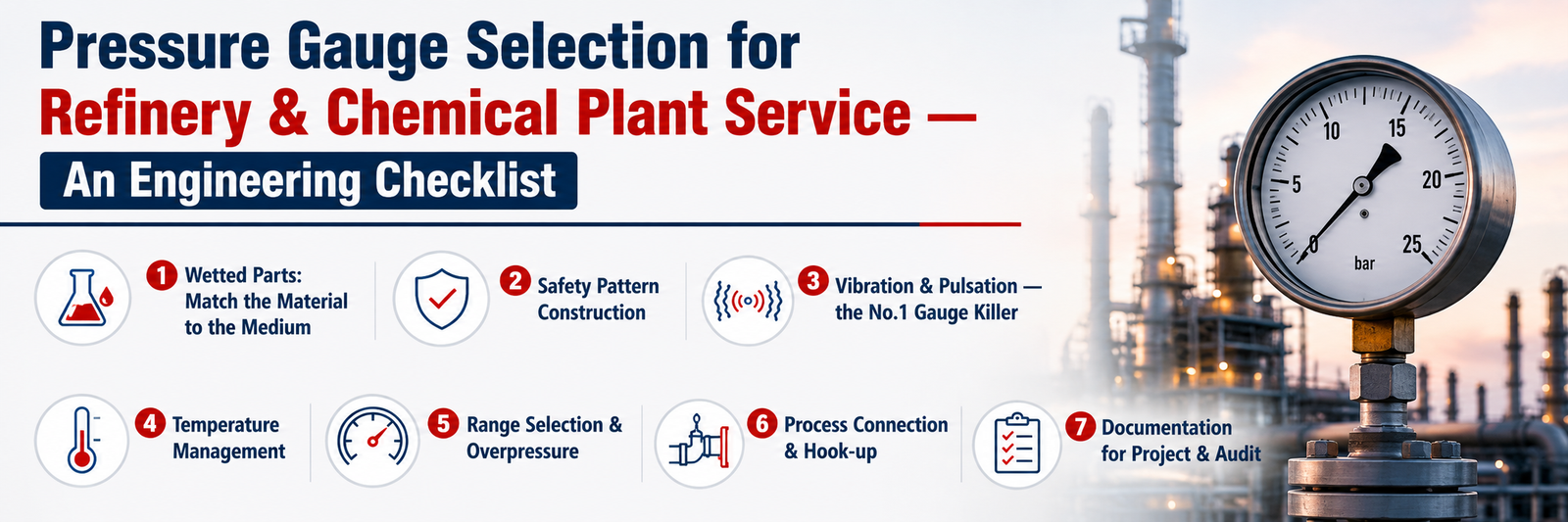
1. Wetted Parts: Match the Material to the Medium
The default industrial gauge has a brass/bronze element — unacceptable for most refinery and chemical media. In most applications, an SS316 pressure gauge is the preferred starting point because of its excellent corrosion resistance and compatibility with a wide range of process fluids.
| Service | Minimum Wetted Parts |
| Hydrocarbons, steam, general process | SS316 pressure gauge element and socket |
| Chlorides, acids, aggressive chemicals | Hastelloy / Monel — or SS316 pressure gauge behind a diaphragm seal |
| Hot concentrated acids | Tantalum diaphragm seal |
| Sour service (H2S — NACE) | Materials per NACE MR0175/ISO 15156 |
For media that corrode, clog, or crystallise, the correct engineering answer is usually a standard SS316 pressure gauge protected by the right diaphragm seal — not an exotic gauge.
2. Safety Pattern Construction
For gases and hazardous liquids, specify safety pattern gauges (solid front, blow-out back) per EN 837-1 S3: a solid baffle wall between element and dial, laminated glass, and a blow-out back that vents an element burst away from the operator’s face. On hydrocarbon and high-pressure gas service this should be the default, not an option.
3. Vibration & Pulsation — the No.1 Gauge Killer
Pumps, compressors, and control valve lines destroy dry gauges through pointer flutter and element fatigue.
| Condition | Specification |
| Vibration / pulsation | Glycerine or silicone filled pressure gauge (dampens movement, lubricates internals) |
| Pressure spikes / pulsating pump discharge | Add a pressure gauge snubber or pulsation dampener |
| Severe pulsation | Silicone filled pressure gauge + pressure gauge snubber together |
A ₹600 pressure gauge snubber routinely doubles the life of a ₹6,000 gauge.
4. Temperature Management
Bourdon tube gauges are typically rated to ~100 °C media temperature (filled versions less). For hot service:
- Steam lines: always a siphon (pigtail/U-type) between tap and gauge — see our Boiler & Steam Instrumentation Solutions.
- Hot process media: capillary-connected diaphragm seal or cooling element.
- High ambient near furnaces: remote mounting via capillary.
5. Range Selection & Overpressure
Select the range so normal operating pressure sits at 50–65% of full scale (EN 837 practice). A gauge run near full scale fatigues early; one run at 10% of scale reads inaccurately. Where overpressure excursions are possible, specify an overload-protected gauge or external overpressure protector.
6. Process Connection & Hook-up
- ½” NPT(M) SS316 is the refinery standard; verify against piping spec.
- Always install with an isolation arrangement — gauge valve or 2-valve manifold — so the gauge can be calibrated or replaced live.
- Orient per medium: liquid-filled lines need venting consideration; steam needs the siphon filled before pressurising.
7. Documentation for Project & Audit
For refinery projects, the gauge is only as good as its papers: material test certificates (MTC 3.1), calibration certificate (NABL where required), NACE compliance certificate for sour service, and IP rating declaration. Specify documentation at enquiry stage — retro-fitting certificates later is painful.
Quick Specification Table — Typical Refinery Duties
| Application | Typical Specification |
| Pump discharge (hydrocarbon) | SS316 pressure gauge, glycerine filled, safety pattern, pressure gauge snubber, 0–2× operating pressure |
| Steam header | SS316 pressure gauge, dry, siphon, range per design pressure |
| Acid / chloride service | SS316 pressure gauge + Hastelloy diaphragm seal assembly |
| Compressor discharge | SS316 pressure gauge, silicone filled pressure gauge, pressure gauge snubber, safety pattern |
| Utility air / water | SS316 pressure gauge economy, dry |
How Machine Tools Centre Supports Refinery & Chemical Buyers
We specify against your line conditions — medium, pressure, temperature, vibration, piping class — and supply complete engineered assemblies (gauge + seal + siphon + pressure gauge snubber + manifold) with full documentation, from brands like WIKA and other trusted makes. Our expertise in instrumentation for refinery plant India helps buyers source compatible, project-ready solutions through one engineered enquiry instead of five separate part numbers that may not fit together.
Conclusion
On refinery and chemical service, gauge selection is a materials-and-protection exercise: the right SS316 pressure gauge, safety pattern construction, a silicone filled pressure gauge or pressure gauge snubber for vibration control, a siphon or seal for temperature protection, range at mid-scale, and an isolation valve so it can be maintained. Get those right and a pressure gauge quietly does its job for years.
Share your line list or service conditions with Machine Tools Centre and we will return a properly engineered gauge specification and quotation.
Contact Machine Tools Centre
📞 +91 7596 0406 21
📧 dm@mtcin.com
🌐 mtcin.com

