

Every industrial facility, from a small manufacturing unit to a large petrochemical plant, depends on accurate measurement. Pressure gauges, temperature sensors, flow meters, and analytical instruments all feed data into decisions that affect safety, quality, and cost. Over time, however, even the best instruments drift from their true readings. This is where instrument calibration becomes essential — not as an occasional formality, but as a continuous discipline that keeps operations reliable.
What Is Instrument Calibration?
Instrument calibration is the process of comparing the readings of an instrument against a known, traceable standard and adjusting it to eliminate deviations. If a pressure transmitter shows 100 psi when the actual pressure is 98 psi, calibration identifies this gap and corrects it, or at least documents the error so operators can account for it. The goal is simple: ensure that what an instrument reports is what is actually happening in the process.
Calibration is different from simple maintenance. Maintenance keeps an instrument functioning; calibration keeps it accurate. A gauge can be working perfectly and still be calibrated incorrectly, leading to silent errors that are far more dangerous than an obvious malfunction, because nobody notices until something goes wrong downstream.
Why Instrument Calibration Matters
- Product quality and consistency In industries like pharmaceuticals, food processing, and chemicals, even small measurement errors can alter batch quality or violate regulatory limits. Calibrated instruments help maintain consistency across production runs.
- Safety compliance Pressure relief systems, temperature interlocks, and flow safety devices rely on correct readings to trigger at the right moment. An uncalibrated instrument can fail to signal a dangerous condition, putting personnel and equipment at risk.
- Regulatory and audit requirements Standards such as ISO 9001, ISO/IEC 17025, and various industry-specific regulations require documented calibration records. Auditors routinely check calibration certificates and traceability to national or international standards.
- Cost control Miscalibrated instruments can cause overuse of raw materials, energy wastage, or unnecessary equipment wear. Regular calibration often pays for itself by preventing these inefficiencies.
Common Instruments That Require Calibration
- Pressure gauges and transmitters
- Temperature sensors, thermocouples, and RTDs
- Flow meters (electromagnetic, ultrasonic, differential pressure types)
- Level instruments
- Analytical instruments such as pH meters and conductivity meters
- Weighing scales and load cells
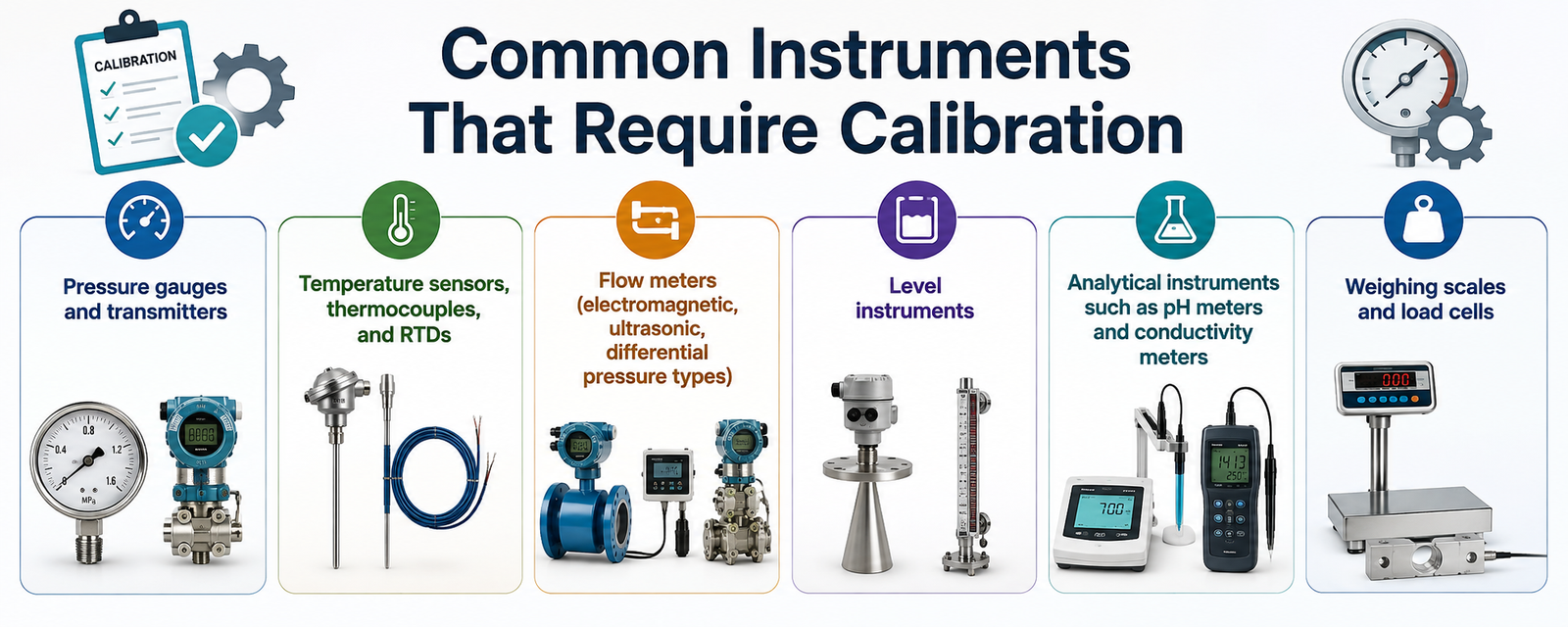 Each instrument type has its own calibration procedure, reference standards, and acceptable tolerance limits, which is why calibration is best handled by technicians trained on the specific instrument category.
How Often Should Instruments Be Calibrated?
There is no single answer that fits every instrument or industry. Calibration frequency depends on:
- Manufacturer recommendations
- Criticality of the measurement (safety-critical instruments need more frequent checks)
- Environmental conditions (harsh environments accelerate drift)
- Regulatory requirements specific to the sector
- Historical performance and drift patterns of the instrument
A common starting point is annual calibration, with more frequent checks (quarterly or semi-annual) for critical process instruments. Facilities with strong historical data sometimes extend intervals if an instrument consistently shows minimal drift.
In-House vs. Third-Party Calibration Services
Some larger facilities maintain in-house calibration labs, but this requires investment in reference standards, trained personnel, and environment-controlled spaces. For most companies, especially small and mid-sized manufacturers, working with professional instrument calibration services is more practical. Third-party providers bring traceable standards, accredited processes, and documentation that satisfies audit requirements without the overhead of maintaining an internal lab.
Finding the Right Calibration Partner
If you’re searching for instrument calibration services in Kolkata or looking for instrument calibration services in India more broadly, it helps to evaluate providers on a few key points:
- Traceability to national/international standards (like NPL or NABL accreditation)
- Range of instruments they can calibrate
- Turnaround time and on-site vs. lab calibration options
- Documentation and certificate quality
- Industry experience relevant to your sector
Searching for “instrument calibration near me” is a natural first step, but proximity alone shouldn’t be the deciding factor — accreditation and technical expertise matter just as much, particularly for instruments tied to safety or regulatory compliance.
A Trusted Name in Industrial Instrumentation
For companies looking for dependable instrumentation and calibration support, MTC India offers a strong track record across process instrumentation, including manifold valves, electromagnetic flow meters, and ETP instrumentation solutions. Their experience across diverse industrial applications makes them a reliable choice for facilities that need both quality instruments and the calibration expertise to keep them accurate over time.
Final Thoughts
Instrument calibration isn’t a one-time task to check off a compliance list — it’s an ongoing commitment to accuracy, safety, and operational efficiency. Whether you manage a small workshop or a large industrial plant, building a consistent calibration schedule, backed by a reliable service provider, protects your processes from the hidden costs of measurement drift. Investing in proper calibration today prevents far costlier problems tomorrow, from failed audits to safety incidents that could have been avoided with a simple, timely check.

