
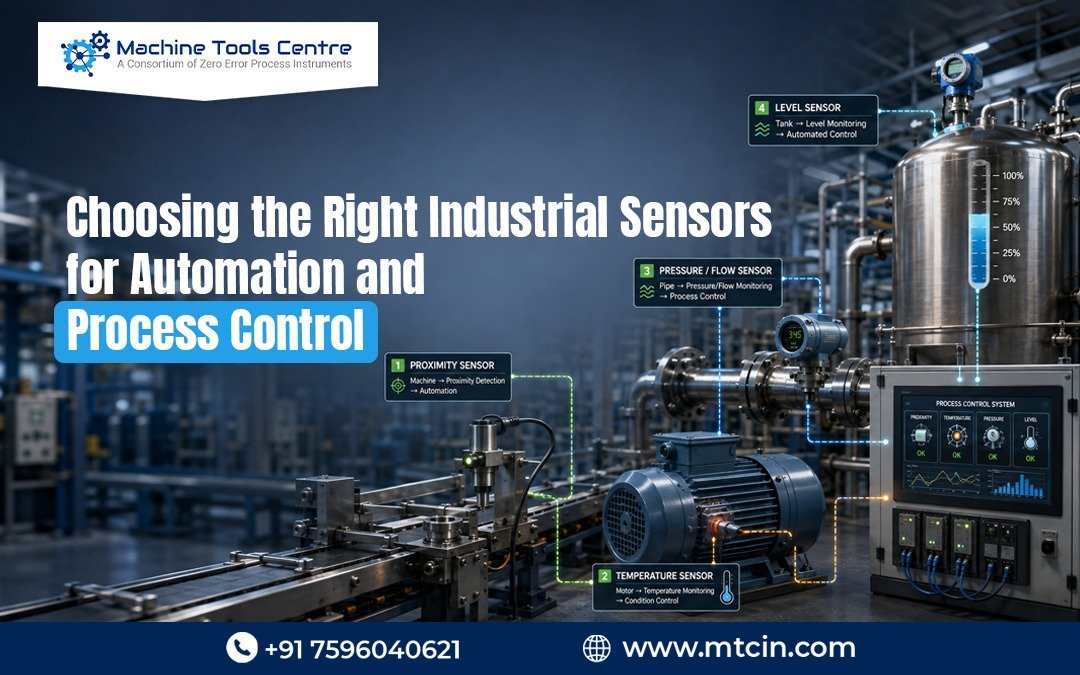
Modern industrial operations depend heavily on accurate data. Whether it is monitoring temperature, pressure, flow, position, level, or speed, industries need reliable devices that can collect real-time information and support automated decision-making. This is where industrial sensors play a critical role.
From manufacturing plants and power generation facilities to chemical processing and packaging lines, sensors help improve efficiency, safety, accuracy, and process control. However, with numerous industrial sensors types available in the market, choosing the right sensor for a particular application can sometimes be challenging.
This guide explains the important factors involved in industrial sensors selection and how businesses can choose suitable solutions for their automation and process control requirements.
Understanding Industrial Sensors
Industrial sensors are devices designed to detect, measure, and monitor physical changes in an industrial environment. They convert physical parameters into signals that can be interpreted by machines, controllers, PLCs, or other automation systems.
Sensors allow automated systems to understand what is happening during a process. For example, a temperature sensor can monitor heat inside industrial equipment, while a pressure sensor can detect changes in pressure levels within a pipeline.
Without accurate sensor data, automation systems cannot respond effectively to changing operating conditions.
Common Industrial Sensors Types
Different industrial applications require different types of sensors. Some commonly used industrial sensors include:
Temperature Sensors
Temperature sensors are used to monitor and control temperature in industrial processes. They are commonly found in boilers, furnaces, HVAC systems, food processing units, and chemical plants.
RTDs, thermocouples, and thermistors are some widely used temperature sensing technologies.
Pressure Sensors
Pressure sensors measure the pressure of gases and liquids. They are important in hydraulic systems, pneumatic systems, boilers, compressors, and process plants.
Accurate pressure monitoring can help improve safety and prevent equipment damage.
Proximity Sensors
Proximity sensors detect the presence or absence of an object without physical contact. These sensors are widely used in automated manufacturing and assembly lines.
Inductive, capacitive, ultrasonic, and photoelectric sensors are commonly used for proximity detection.
Level Sensors
Level sensors monitor the level of liquids, powders, and other materials inside tanks, vessels, and containers. They are commonly used in industries such as water treatment, chemicals, pharmaceuticals, and food processing.
Flow Sensors
Flow sensors measure the movement of liquids or gases through pipelines. Accurate flow measurement is essential for process monitoring, production control, and resource management.
Position and Motion Sensors
These sensors detect movement, position, speed, or rotation. They are often used in robotics, CNC machines, conveyor systems, and automated equipment.
Understanding different industrial sensors types is the first step toward selecting the most suitable solution for a particular industrial application.
Factors to Consider During Industrial Sensors Selection
Choosing a sensor is not simply about selecting a device that can measure a specific parameter. The sensor must also perform reliably within the actual operating environment.
Here are some important factors to consider during industrial sensors selection.
1. Define the Application Requirement
The first step is to clearly understand what needs to be measured or detected.
Ask important questions such as:
- What parameter needs to be monitored?
- What measurement range is required?
- How accurate should the measurement be?
- Is continuous monitoring required?
- What output signal is compatible with the existing system?
A clear understanding of the application makes the industrial sensors selection process much easier.
2. Consider the Operating Environment
Industrial environments can be demanding. Sensors may be exposed to high temperatures, moisture, dust, vibration, chemicals, or electromagnetic interference.
The selected sensor should be suitable for these environmental conditions. Choosing an unsuitable sensor may result in inaccurate readings, frequent failures, and unnecessary maintenance costs.
3. Check Accuracy and Measurement Range
Every application has different requirements for accuracy and range. A sensor should provide the required level of precision while operating within its recommended measurement range.
Selecting a sensor with an incorrect range can affect both performance and reliability.
4. Evaluate Output and Connectivity
Modern automation systems use different communication and output methods. Depending on the application, sensors may provide analogue signals, digital signals, or communication through industrial protocols.
The sensor should be compatible with PLCs, controllers, SCADA systems, and other equipment already used in the facility.
5. Consider Installation and Maintenance
Easy installation and maintenance can reduce operational downtime. Businesses should consider sensor mounting requirements, calibration needs, accessibility, and replacement availability before making a final decision.
A reliable sensor that is easy to maintain can provide long-term value.
Understanding the Industrial Sensors Selection Process
A structured industrial sensors selection process helps businesses avoid costly mistakes. The process generally involves the following steps:
- Identify the parameter that needs to be measured.
- Define the required measurement range and accuracy.
- Evaluate the industrial environment.
- Check compatibility with the automation system.
- Compare available sensor technologies.
- Review reliability, maintenance, and lifecycle requirements.
- Choose a trusted supplier or manufacturer.
Following these steps helps ensure that the selected sensor meets both technical and operational requirements.
Why Choosing the Right Manufacturer Matters
With many industrial sensors manufacturers available in the market, businesses should look beyond product specifications alone. The right supplier can help customers understand application requirements and select suitable products.
Technical support, product availability, quality assurance, and industry experience are also important factors when choosing a sensor supplier.
For businesses looking for reliable industrial automation and instrumentation solutions, MTC Machine Tool Centre offers a range of products and solutions for industrial applications. Through mtcin.in, businesses can explore industrial products and connect with professionals for suitable automation, measurement, and control requirements.
Having access to the right products and technical guidance can make the selection process more efficient and help businesses choose solutions based on their specific operational needs.
Conclusion
Industrial automation depends on accurate and reliable data, and sensors are an essential part of this process. With numerous industrial sensors types available, selecting the right solution requires careful evaluation of the application, environment, accuracy, connectivity, and maintenance requirements.
A proper industrial sensors selection process can improve operational efficiency, reduce downtime, support better process control, and enhance workplace safety.
By understanding application requirements and working with reliable industrial sensors manufacturers and suppliers, businesses can make better decisions for their automation systems. For industrial automation, instrumentation, and machine-related requirements, mtc can be a useful platform to explore suitable solutions and connect with MTC Machine Tool Centre.
The right sensor may be a small component in a large industrial system, but its role in maintaining accurate, efficient, and reliable operations is significant.

