
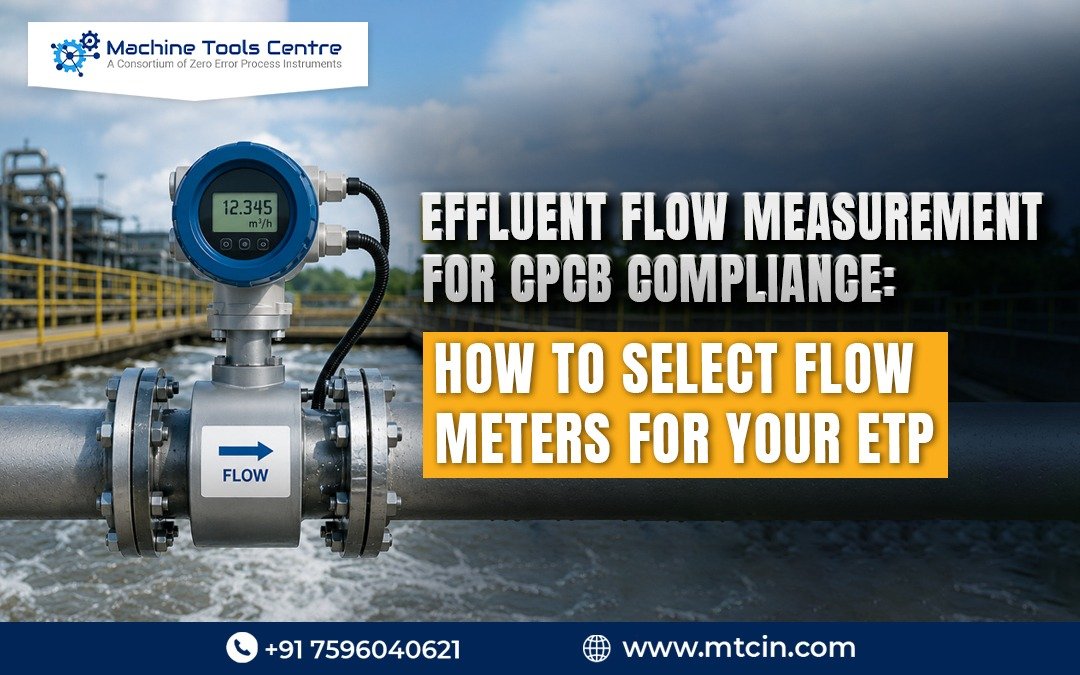
For most plants, the effluent flow meter India installs at the ETP outlet is no longer just a process instrument — it is a compliance instrument. Pollution Control Boards across India increasingly require industries to monitor and report treated effluent discharge, and for the highly polluting industry categories, CPCB mandates Online Continuous Effluent Monitoring Systems (OCEMS) with real-time data transmission to CPCB/SPCB servers.
The result: a flow meter that “roughly works” is not enough anymore. A CPCB OCEMS flow meter must read correctly in dirty media, log totalised discharge, and talk to your telemetry system. This guide covers how to get that selection right as part of a complete ETP instrumentation online monitoring India setup. For the complete instrumentation picture of an ETP, see our ETP Instrumentation & Online Monitoring Solutions page.
Where Flow Must Be Measured in an ETP
| Measurement Point | Why It Matters |
| Inlet (raw effluent) | Hydraulic load on the plant; basis for treatment dosing |
| Chemical dosing lines | Coagulant/polymer dosing accuracy = treatment cost control |
| Recycle / sludge lines | Process balance, sludge management |
| Final outlet (treated discharge) | The compliance point — totalised discharge reported to PCB |
The outlet meter is the one your auditor and the Pollution Control Board care about. It deserves the most careful selection.
Why Electromagnetic Flow Meters Dominate ETP Service
Treated and untreated effluent is conductive, dirty, and often carries suspended solids — conditions where mechanical meters foul and ultrasonic meters can struggle with entrained air. An electromagnetic flow meter has no moving parts, no obstruction, near-zero pressure loss, and handles solids easily, which is why it is the default choice for any effluent flow meter India ETPs rely on.
| Requirement (ETP service) | Electromagnetic Meter |
| Suspended solids / sludge | Handles well (no moving parts) |
| Accuracy for reporting | ±0.5% typical — audit-grade |
| Totaliser for daily discharge | Built-in |
| 4-20 mA / pulse / RS485 output for OCEMS | Standard options |
| Maintenance | Minimal — periodic electrode/liner inspection |
For pricing and sizing of mag meters, see our Electromagnetic Flow Meter Price in India 2026 guide. The key conditions: medium must be conductive (effluent always is) and the pipe must run full at the metering point.
Open Channel Discharge? Different Instrument
Many ETPs discharge through an open drain or channel, not a closed pipe. A mag meter cannot be used there. For an online effluent monitoring system India setup with open-channel discharge, the options are:
- Ultrasonic level-based open channel flow meter over a V-notch weir or Parshall flume — the standard CPCB-accepted arrangement.
- The primary element (weir/flume) must be constructed to dimension standards, otherwise the computed flow is wrong regardless of instrument quality
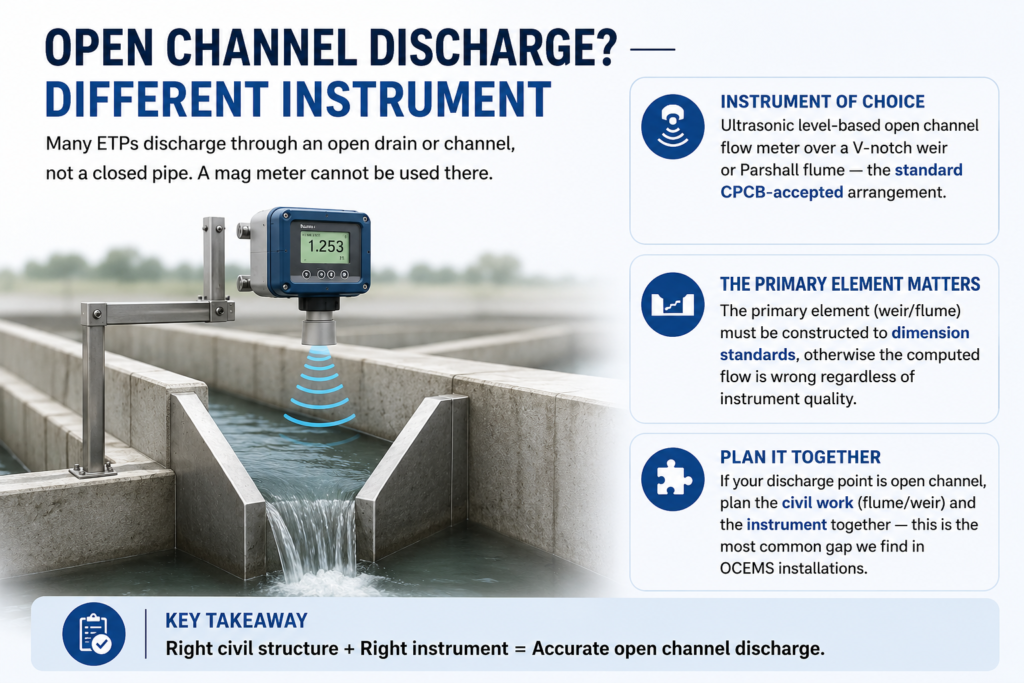
If your discharge point is open channel, plan the civil work (flume/weir) and the instrument together — this is the most common gap we find in OCEMS installations.
OCEMS Connectivity — What PCB Expects
For mandated categories, flow data must reach the regulator, not just the local display. This is the backbone of any CPCB OCEMS flow meter installation:
- Meter output (4-20 mA / RS485 Modbus) wired to a data logger / RTU
- Logger transmits to CPCB/SPCB server in the prescribed protocol
- Totalised daily discharge retained and retrievable for inspection
- Calibration records maintained — an uncalibrated compliance meter is a finding waiting to happen
Pair the flow meter with the rest of the online monitoring chain (pH, BOD/COD, TSS analysers) — covered on our ETP solutions page.
Installation Checklist for the Outlet Meter
- Straight length: typically 5D upstream / 3D downstream minimum
- Full pipe guaranteed — install in a rising line or U-section if needed
- Proper earthing/grounding rings — the most skipped step, and the top cause of unstable mag meter readings in ETPs
- IP68 remote sensor if the meter sits in a pit that can flood
- Isolation arrangement for meter service without stopping discharge
- Periodic calibration with traceable certificate
Common Compliance Mistakes We See
- Meter sized to the pipe, not the flow — reads poorly at actual discharge rates
- No totaliser configured — daily discharge being “estimated” in the log book
- Flume dimensions non-standard, making open-channel readings meaningless
- Grounding rings omitted to save cost — erratic readings during inspection
- No calibration record when PCB asks for it
How Machine Tools Centre Supports ETP Compliance
We supply and support the complete effluent monitoring chain — electromagnetic and open-channel flow meters, level, pH and analytical instruments, data logging and OCEMS connectivity — engineered for your discharge arrangement as part of a complete ETP instrumentation online monitoring India package. We review your outlet configuration (closed pipe vs open channel), flow range, and PCB requirements before recommending the instrument.
Conclusion
Effluent flow measurement is now part of your compliance file, not just your process data. Select by application — mag meter for closed pipes, flume + ultrasonic for open channels — size by actual flow, ground it properly, calibrate it on schedule, and connect it to OCEMS where mandated. The right effluent flow meter India installs at the outlet is the foundation of an audit-ready online effluent monitoring system India regulators will accept without question.
Share your ETP discharge details with Machine Tools Centre and we will recommend a compliant, audit-ready metering solution.
Contact Machine Tools Centre
📞 +91 7596 0406 21
📧 dm@mtcin.com
🌐 mtcin.com

