
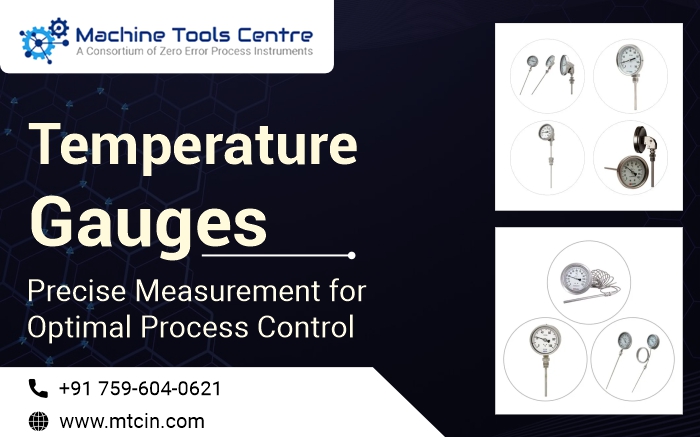
As a leading process automation solution provider, Machine Tools Centre understands the critical role temperature gauges play in ensuring efficient and accurate operations across diverse industries. From manufacturing to chemical processing, and pharmaceutical production to food and beverage, monitoring and maintaining precise temperatures is essential for product quality, safety, and regulatory compliance.
What is a Temperature Gauge?
A temperature gauge is an instrument designed to measure and display the temperature of a specific substance, object, or environment. These devices work with various principles, such as thermal expansion, electrical resistance, or radiation emission, to quantify temperature readings accurately.
Types of Temperature Gauges
The world of temperature gauges is diverse, with each type offering unique advantages and applications:
- Bimetallic Thermometers: Utilizing the differing thermal expansion rates of two bonded metal strips, bimetallic thermometers provide a simple and cost-effective solution for many industrial applications.
- Resistance Temperature Detectors (RTDs): RTDs rely on the predictable change in electrical resistance of certain metals as temperatures fluctuate, offering high accuracy and stability over a wide range.
- Thermocouples: By exploiting the thermoelectric effect, thermocouples generate a voltage proportional to the temperature difference between two dissimilar metals, making them ideal for high-temperature environments.
- Infrared Thermometers: These non-contact devices measure the infrared radiation emitted by an object, allowing for temperature monitoring without direct contact, which is beneficial in hazardous or inaccessible areas.
- Digital Thermometers: Combining temperature sensors with digital displays, these user-friendly devices provide precise temperature readings in various units, often with additional features like data logging and alarms.
Your Input Matters – Share Your Needs
Key Features of Temperature Gauges
When selecting a temperature gauge, several key features should be considered:
Accuracy and Precision
The gauge’s ability to provide reliable and consistent temperature measurements is crucial, especially in critical applications.
Temperature Range
Different gauges are designed for specific temperature ranges, ensuring compatibility with the intended application.
Response Time
The speed at which a gauge reacts to temperature changes can be critical in dynamic processes or time-sensitive operations.
Durability and Robustness
Industrial environments can be harsh, necessitating temperature gauges that can withstand extreme conditions, vibrations, and shocks.
Connectivity and Data Integration
Modern gauges often offer connectivity options, allowing for seamless integration with control systems, data logging, and remote monitoring.
Choosing the Right Temperature Gauge
At Machine Tools Centre, our experts understand that selecting the most suitable temperature gauge is essential for optimizing processes and ensuring consistent quality. We work closely with our clients to evaluate their specific requirements, considering factors such as temperature range, accuracy needs, process conditions, and integration with existing systems.
Innovations and Future Trends
The temperature gauge industry is continuously evolving, driven by advancements in sensor technology, data analysis, and connectivity. Some notable trends include:
- Wireless Temperature Monitoring: Enabling remote data collection and real-time monitoring, wireless temperature gauges enhance efficiency and reduce operational costs.
- Internet of Things (IoT) Integration: With the rise of IoT, temperature gauges are becoming increasingly interconnected, allowing for smooth data sharing and centralized monitoring across dispersed locations.
- Advanced Analytics and Predictive Maintenance: By leveraging machine learning and big data analytics, temperature gauge data can be used to identify patterns, predict maintenance needs, and optimize processes proactively.
- Miniaturization and Flexibility: Advancements in microfabrication techniques are leading to smaller, more flexible, and versatile temperature gauges, expanding their applications in confined spaces or on complex surfaces.
Conclusion
Temperature gauges are indispensable tools in the world of process automation, ensuring precise measurement and control of critical parameters. At Machine Tools Centre, we pride ourselves on providing innovative temperature gauge solutions designed to our clients’ unique needs. With our deep industry knowledge and commitment to innovation, we empower our customers to achieve unparalleled process efficiency, quality, and safety.
Contact us today to explore how our temperature gauge offerings can optimize your operations and drive your business forward.
FAQS
What is a Temperature Gauge Used for?
A temperature gauge is used to measure and display the temperature of a system or environment. It is commonly employed in various industries to monitor the temperature of liquids, gases, and solids, ensuring processes are operating within safe and efficient temperature ranges.
What is the Principle of a Temperature Gauge?
The principle of a temperature gauge typically involves the thermal expansion of materials or the electrical resistance changes due to temperature variations. For example, a bimetallic strip gauge works on the principle of differential expansion of two metals, while a thermocouple gauge relies on the voltage difference generated at the junction of two different metals when exposed to temperature changes.
What is the Unit of a Temperature Gauge?
The unit of a temperature gauge is typically degrees Celsius (°C) or degrees Fahrenheit (°F). Some scientific and industrial applications may use Kelvin (K).
What is the Most Accurate Temperature Gauge?
The most accurate temperature gauge is generally considered to be a platinum resistance thermometer (PRT) or a thermistor. These devices offer high precision and stability over a wide range of temperatures, making them suitable for critical applications requiring exact temperature measurements.

