
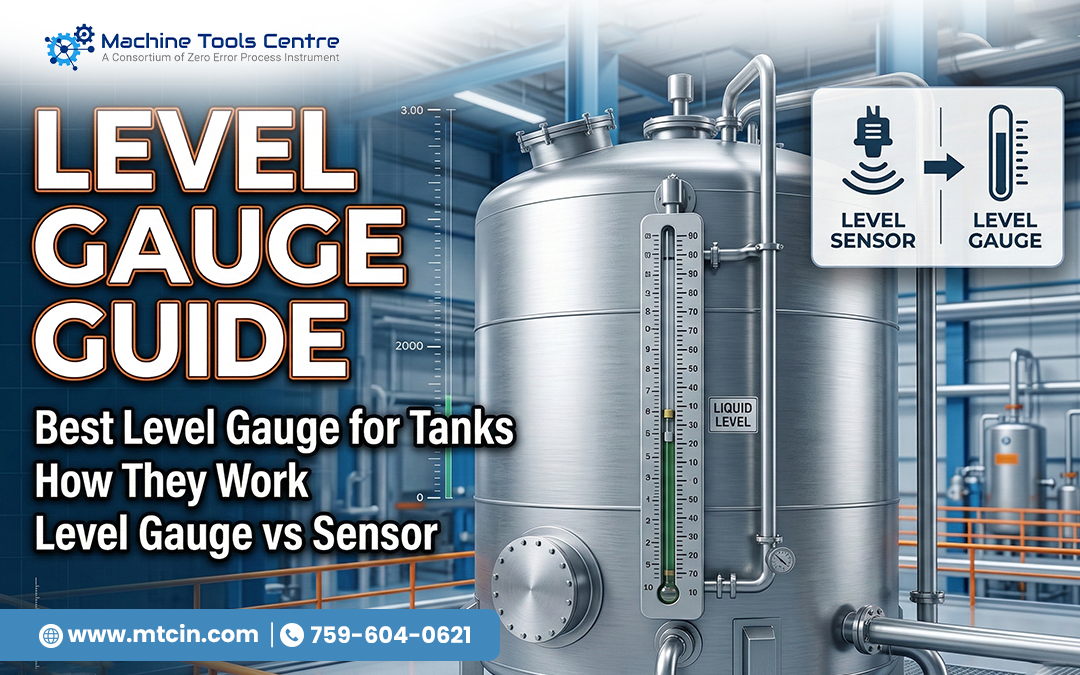
In every factory, there is one small device that silently protects production, safety, and cost the level gauge.
Whether it is a water tank on the terrace, a coolant tank in a CNC machine, a diesel storage tank, or a chemical processing unit, knowing the correct liquid level is not optional. It is necessary.
Overflow wastes material.
Dry running damages pumps.
Wrong readings create safety risks.
This blog is written to clear three common questions:
- What is the best level gauge for tanks?
- How do level gauges work?
- What is the difference between a level gauge and a level sensor?
And most importantly, how to choose the right one for your industry.
As one of the largest distributors of industrial products in India, Machine Tool Centre has worked closely with manufacturing plants, process industries, OEMs, and maintenance teams for years. So this guide is practical, simple, and based on real application needs — not theory.
What Is a Level Gauge?
A level gauge is a device used to visually or electronically measure the level of liquid inside a tank.
Level gauges are used in:
- Water tanks
- Oil tanks
- Fuel storage
- Coolant tanks
- Chemical tanks
- Food & beverage processing
- Pharmaceutical plants
- Boilers
Without proper level monitoring, operations become guesswork.
Best Level Gauge for Tanks – How to Choose?
There is no single “best” level gauge for all tanks. The right choice depends on:
- Type of liquid
- Temperature
- Pressure
- Tank size
- Budget
- Required accuracy
- Manual or automatic monitoring
Let’s understand the most common types used in Indian industries.
Sight Glass Level Gauge
This is the most basic and widely used type.
It uses a transparent glass tube attached to the tank. The liquid level inside the glass shows the actual tank level.
Best for:
- Water tanks
- Oil tanks
- Low-pressure applications
Advantages:
- Simple design
- Low cost
- No power required
- Easy maintenance
Limitations:
- Not ideal for very high pressure
- Glass may break in harsh environments
Magnetic Level Gauge
This is more advanced. It uses a float inside a chamber and magnetic indicators outside.
When the liquid level rises, the float moves up. The magnetic strip outside shows the level clearly.
Best for:
- Chemical industries
- High temperature liquids
- High pressure tanks
Advantages:
- No direct contact with glass
- Long life
- Safe for hazardous liquids
Float & Board Type Gauge
A simple mechanical system using a float connected to an indicator board.
Best for:
- Large overhead tanks
- Water storage
- Agriculture use
Electronic / Digital Level Gauge
This system uses sensors and gives digital readings. It can connect to alarms and automation systems.
Best for:
- Automated plants
- CNC coolant tanks
- Process industries
- Remote monitoring
Comparison Table – Best Level Gauge for Tanks
| Type | Power Needed | Accuracy | Cost | Best For | Maintenance |
| Sight Glass | No | Medium | Low | Water, Oil | Low |
| Magnetic Level Gauge | No | High | Medium | Chemicals | Very Low |
| Float Type | No | Medium | Low | Large Water Tanks | Low |
| Digital / Electronic | Yes | Very High | Higher | Automation Systems | Medium |
There is no universal best option. The best level gauge is the one that matches your tank conditions.
This is where expert guidance matters.
At Machine Tool Centre, the team understands application details before recommending any product. That is the reason industries trust them — not just for supply, but for correct technical selection.
How Level Gauges Work – Simple Explanation
Now let us understand the working principle in very easy language.
Different level gauges use different methods.
Visual Principle
In sight glass gauges, the liquid naturally rises to the same level inside the glass tube as in the tank.
This happens due to the basic principle of fluid connection.
If tank level increases → glass level increases.
If tank level decreases → glass level decreases.
Float Principle
Float-based gauges work like this:
- A hollow float rests on the liquid surface.
- When liquid rises, float moves up.
- This movement is transferred mechanically or magnetically to an indicator.
It works similar to how a float works in a water tank at home.
Magnetic Principle
In magnetic gauges:
- Float contains a magnet.
- As float moves, it rotates magnetic indicator flags outside the chamber.
- Color change shows liquid level.
No external power required.
Electronic Sensor Principle
Digital level gauges use sensors like:
- Ultrasonic
- Capacitive
- Conductive
- Pressure-based
These sensors detect level and convert it into electrical signals.
The signal is shown on:
- Digital display
- PLC system
- Alarm panel
- SCADA system
This is useful for industries where manual checking is not practical.
Level Gauge vs Level Sensor – What Is the Difference?
Many people get confused between these two.
Let us make it very clear.
| Feature | Level Gauge | Level Sensor |
| Main Function | Shows liquid level | Detects level and sends signal |
| Output | Visual reading | Electrical signal |
| Power Required | Usually No | Yes |
| Use | Manual monitoring | Automation systems |
| Example | Sight glass | Ultrasonic sensor |
In simple words:
A level gauge shows the level. A level sensor informs the system about the level.
In modern plants, both are often used together.
For example:
- Sight glass for visual confirmation
- Sensor for automatic pump control
That combination gives safety + automation.
Where Are Level Gauges Most Important?
Let us look at some real industry cases.
Manufacturing Plants
Coolant tanks in CNC machines must maintain proper level. Low level damages pumps.
Chemical Industry
Overfilling hazardous chemicals can cause safety issues.
Oil & Fuel Storage
Accurate level measurement prevents losses.
Boiler Systems
Water level must be maintained precisely to avoid breakdown.
Food Industry
Hygienic stainless steel level gauges are used. In all these sectors, product quality and reliability matter. That is why industries across India depend on experienced distributors like Machine Tool Centre, who ensure genuine, tested, and industry-approved products.
Common Mistakes While Selecting Level Gauge
Many buyers focus only on price. That creates problems later.
Avoid these mistakes:
- Ignoring temperature rating
- Not checking pressure limit
- Selecting wrong material (MS instead of SS)
- Choosing low accuracy for critical process
- Not considering future automation
A proper supplier always asks application questions before suggesting a product.
Why Machine Tool Centre Is Trusted in India
When it comes to industrial distribution, product knowledge matters as much as product quality.
Machine Tool Centre is known for:
- Wide range of industrial solutions
- Technical understanding
- Support before and after sales
- Fast supply across India
- Genuine and reliable brands
We do not just sell products. We understand plant requirements. That is the difference between a trader and a professional distributor.
Conclusion
A level gauge may look like a small device, but its impact on production, safety, and cost is huge.
Choosing the best level gauge for tanks depends on:
- Liquid type
- Tank size
- Environment
- Automation requirement
- Budget
Understanding how level gauges work helps you make smarter decisions.
Knowing the difference between a level gauge and a level sensor prevents wrong purchases. If you are planning to install or upgrade your tank monitoring system, always consult an experienced supplier. Because in industry, small measurement mistakes can create big operational problems. For reliable level gauges and expert guidance, industries across India trust Machine Tool Centre.

