
Some process media simply cannot be allowed to touch your pressure instrument. Acids eat the sensing element. Slurries block the pressure port. Hot polymer solidifies inside the bourdon tube. Hygienic processes can’t tolerate a dead pocket where product collects.
The engineering answer to all four problems is the same: a diaphragm seal (chemical seal). Whether you’re using a diaphragm seal pressure gauge or a chemical seal pressure transmitter, the seal isolates the instrument from aggressive process conditions while maintaining accurate pressure measurement. In this article we explain when a diaphragm seal is genuinely needed, how it works, and the selection decisions that decide measurement accuracy. For the complete engineering methodology, see our Diaphragm Seal Selection Guide.
How a Diaphragm Seal Works
A thin flexible diaphragm isolates the process from the instrument. The cavity between diaphragm and instrument is filled with a fill fluid (silicone oil, glycerine, or food-grade fluid). Process pressure flexes the diaphragm, and the fill fluid transmits that pressure to the gauge or transmitter, allowing the instrument to read pressure without ever contacting the process medium.
In most industrial applications, a silicone oil fill fluid diaphragm seal offers an excellent balance of temperature stability, response, and long-term reliability, making it the preferred choice for general process service.
Simple idea—but the seal, fill fluid, and instrument must be engineered as one assembled, gas-free system. A poorly filled seal assembly reads wrong from day one.
When Do You Actually Need a Diaphragm Seal?
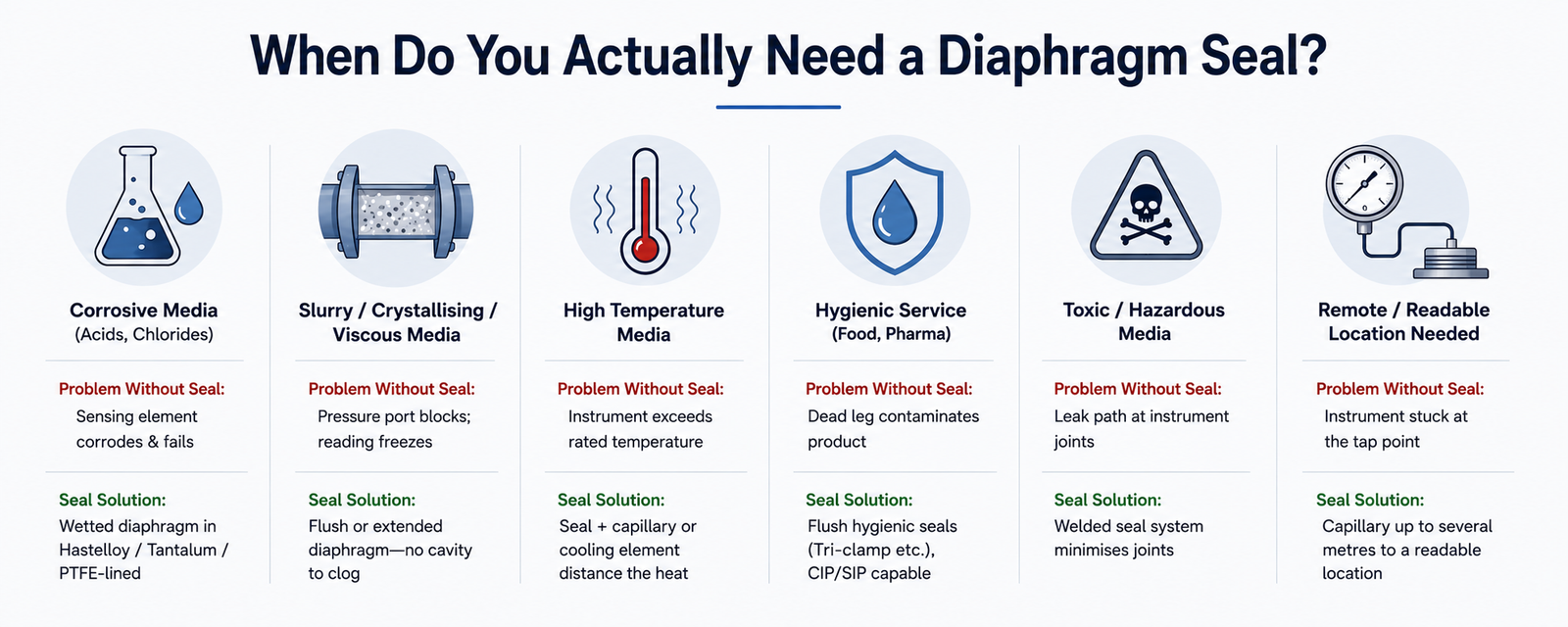
| Process Condition | Problem Without Seal | Seal Solution |
| Corrosive media (acids, chlorides) | Sensing element corrodes & fails | Wetted diaphragm in Hastelloy / Tantalum / PTFE-lined |
| Slurry / crystallising / viscous media | Pressure port blocks; reading freezes | Flush or extended diaphragm—no cavity to clog |
| High temperature media | Instrument exceeds rated temperature | Seal + capillary or cooling element distance the heat |
| Hygienic service (food, pharma) | Dead leg contaminates product | Flush hygienic seals (Tri-clamp etc.), CIP/SIP capable |
| Toxic / hazardous media | Leak path at instrument joints | Welded seal system minimises joints |
| Remote/readable location needed | Instrument stuck at the tap point | Capillary up to several metres to a readable location |
 If none of these conditions exist, you likely don’t need a seal—a correctly specified direct-mounted instrument with a manifold is simpler and more economical.
Seal Mounting Types
| Type | Typical Use |
| Flanged (flush diaphragm) | General chemical service on flanged taps |
| Extended diaphragm | Lined/jacketed vessels, media that builds up on nozzles |
| Threaded / in-line | Smaller lines, OEM equipment |
| Hygienic (Tri-clamp, DIN) | Food, dairy, pharma |
| In-line (flow-through) | No dead space at all—ideal for shear-sensitive or clogging media |
The Decisions That Decide Accuracy
1. Diaphragm Material: Match the diaphragm material to your process medium. A diaphragm seal selection guide helps ensure the right choice.
2. Fill Fluid: A silicone oil fill fluid diaphragm seal is ideal for most industrial applications, while specialised fill fluids suit high-temperature or hygienic service.
3. Capillary Length: Keep capillaries as short as possible to minimise response delay and temperature-related errors, especially with a chemical seal pressure transmitter.
4. Mounting Position: A diaphragm seal pressure gauge or transmitter should be zero-corrected after installation to eliminate mounting-related errors.
5. Factory Assembly: Always use a factory-filled and calibrated chemical seal pressure transmitter or diaphragm seal pressure gauge assembly for reliable performance.
Common Mistakes We See in the Field
- Buying the seal and instrument separately and asking site personnel to assemble them. Diaphragm seal assemblies must be factory-filled and calibrated as one unit.
- Choosing the wrong diaphragm material for the actual concentration or operating temperature of the process medium.
- Installing a 10-metre capillary in direct sunlight, causing readings to drift with changing ambient temperatures.
- Using a standard threaded gauge in hygienic service, creating an unwanted dead leg.
- Using a non-vacuum-rated fill fluid in vacuum applications, allowing the fill fluid to outgas and compromise measurement performance.
How Machine Tools Centre Supports Seal Applications
We engineer the complete sealed assembly—including the instrument, diaphragm seal, fill fluid, and capillary—based on your process medium, operating temperature, and mounting arrangement. Whether you require a diaphragm seal pressure gauge for harsh industrial environments or a chemical seal pressure transmitter for continuous process control, every assembly is supplied factory-filled, calibrated, and ready for installation from trusted brands like WIKA.
For refinery and chemical plant duty, see how sealed systems fit into the bigger instrumentation picture on our Refinery & Chemical Plant Solutions page.
Conclusion
A diaphragm seal is not an accessory—it is half of the measuring instrument. Whether paired with a diaphragm seal pressure gauge or a chemical seal pressure transmitter, successful performance depends on selecting the right diaphragm material for the process medium, the correct fill fluid for the operating temperature, and the appropriate mounting arrangement. Following a proven diaphragm seal selection guide and purchasing the assembly factory-filled and calibrated as one complete system ensures reliable, accurate pressure measurement throughout its service life.
Contact Machine Tools Centre
📞 +91 7596 0406 21
📧 dm@mtcin.com
🌐 mtcin.com

